How the Canal de Bourgogne was built
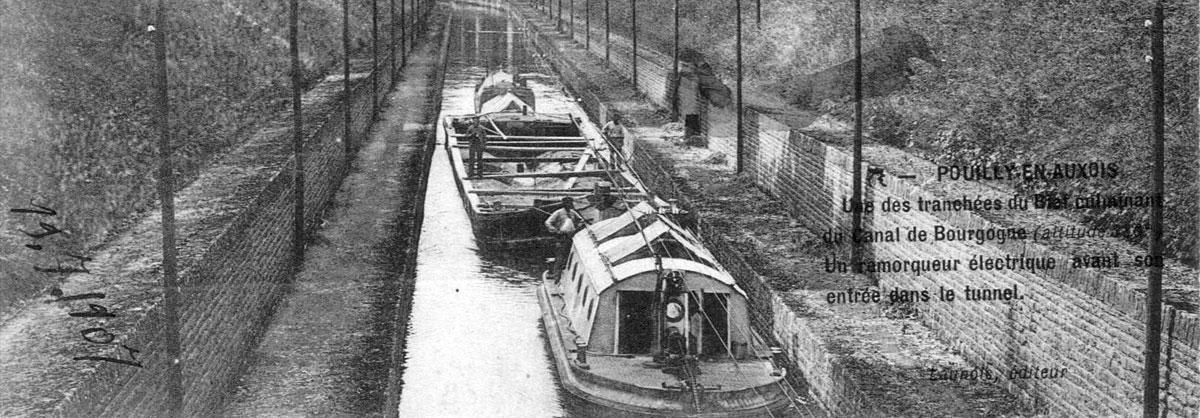
Changing the power… from horse to steam, to diesel and then to electrical power.
The history of the Canal of Burgundy is long and complicated, from the first projects in the 17th century to the actual beginnings of construction, the numerous strikes by the construction workers and builders, and recent political decisions concerning the future financing of the canal. Even today, there is uncertainty and doubt about the viability and use of the waterway.
In 1607 the first act towards the construction of the Burgundy Canal was the tax placed on the local farmers to help the financing of the canal section between Dijon and Saint Jean de Losne. It was not until 1696, when Vauban conducted a study, that he considered that there were five possible routes for the canal to connect the River Saône and the River Yonne. There were many arguments concerning the canal route: civil engineers who disagreed, local mayors who desired the canal to pass as closely as possible, for they understood the economic importance of the trade that would arrive, and landowners wishing to sell at very interesting prices.
A project by Mr de la Jonchere in 1718 saw the canal with its summit at the small town of Sombernon. The States of Burgundy charged Mr Abeille in 1724 with the mission of studying the Pouillenay valley. Three years later, the conclusions concerning the canal were given. The canal's route was finally decided and accepted.
At the beginning of the reign of Louis XVI in 1765, the construction of the Burgundy Canal began on the side of the Yonne working upstream towards the town of Tonnerre, a few years later the work began on the Saône side towards Dijon. The construction cost was assumed by the French state on the Yonne side up to the limits of Burgundy, and the Burgundy state, with a subvention, financed the rest of the construction.
The Yonne side of the canal fell rapidly behind schedule, and due to poor funding, the construction of the canal halted in 1793. The state of Burgundy, however, pushed ahead, and the canal was completed between the city of Dijon and the River Saône. On the 14th of December 1808, the first barges arrived in the port of Dijon. During the revolution, all work was stopped.
Even with Napoleon the 1st's insistence, difficulties concerning the construction, and the continual poor funding of the project, the canal construction could not advance. It was not until 1822, after a loan of 25 million francs, that the enthusiasm and courage came forth to complete the project. On the 28th of December 1832, a barge crossed the canal's summit via the tunnel, and the Burgundy Canal at last connected the north of France to the south; the river Seine connected to the river Rhone.
The final part of the construction of the Burgundy Canal was the complicated engineering of the impressive tunnel at the summit.